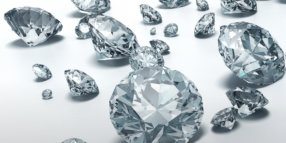
GRADING DIAMONDS USING The 4 C's
CARAT
The weight, and thus the size, of a diamond is measured by carat. A carat is equal to 0.2gm, or 200mg. A carat is divided into 100 smaller units called points. So a diamond weighing three-quarters of a carat is 75 points.
COLOUR
The most valuable and rare colour of a diamond is white, or colourless. Absolutely colourless diamonds are graded with the letter “D”. The Gemmological Institute of America (GIA) diamond colour scale moves up to “Z”. Between these two extremes, diamonds display subtle coloured tones.
CLARITY
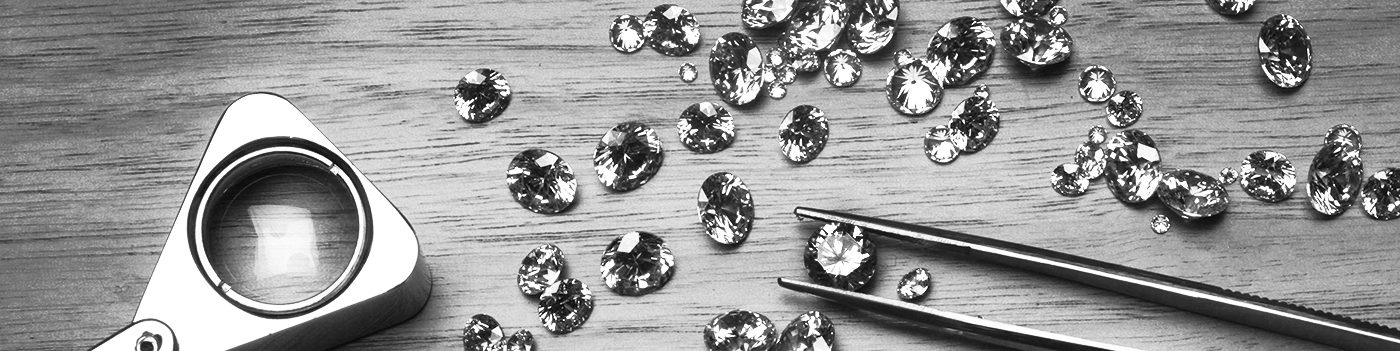
Element welcome you to look into the diamonds in our diamond jewellery with a loupe. You’ll probably see small “inclusions”, or “nature’s fingerprints”. Usually invisible to the naked eye, you need to know that these inclusions can affect the diamond’s fire, but they also make your diamond unique and shouldn’t always be seen as a fault. As long as your diamond is graded above SI1, you can be confident that your diamond will sparkle.
F Flawless: No internal or external flaws. Extremely rare.
IF Internally Flawless: no internal flaws, but some surface flaws. Very rare.
VVS1-VVS2 Very Very Slightly Included (two grades). Minute inclusions very difficult to detect under 10x magnification.
VS1-VS2 Very Slightly Included (two grades). Minute inclusions seen only with difficulty under 10x magnification.
SI1-SI2 Slightly Included (two grades). Minute inclusions more easily detected under 10x magnification.
I1-I2-I3 Included (three grades). Inclusions visible under 10x magnification, as well as to the naked human eye.
CUT
As the only characteristic of a diamond not influenced by nature, a well cut diamond is of vital importance in giving a diamond its brilliance. Each angle and finish affects its ability to handle light, through each facet, which leads to brilliance. A diamond cut to achieve good symmetry and proportion will sparkle more than one that has been cut too deep or shallow.
Cut also determines shape. The most popular diamond shape is the round. Others shapes include princess, emerald, pear, marquise, oval and heart shape. Many of the diamond rings in our designer engagement ring collections boast unusual cuts.
FAQs ABOUT NON-CONFLICT DIAMONDS
Diamonds are mined in parts of Africa, Canada, Russia and Australia. A few years ago the jewellery industry learned that in some parts of Africa, small scale diamond mining was being exploited by illegal militias to support civil war and conflict. These diamonds have been called “Conflict Diamonds” or sometimes “Blood Diamonds”.
The Kimberley Process was designed by the United Nations and the World Diamond Council to prevent conflict diamonds from entering the legitimate jewellery supply chains. Around 70 countries now participate in the Kimberley Process to make sure that where they have diamond mining it is strictly supervised and that diamonds, in their “rough” state (before cutting and polishing) can only be transferred between participating countries in tamper proof containers, under strict controls and with the appropriate documentation. All shipments are reconciled internationally.
Yes, it’s called Blood Diamond with Leonardo DiCaprio as a diamond smuggler in Sierra Leone. It was first screened in January 2007. It is set in the nineties before the trade got to grips with the problem, so it doesn’t reflect what is happening now.
It’s highly unlikely- the Kimberley Process came into force in January 2003 and by now it covers over 99% of the world diamond trade.
Also, most of the conflicts in Africa are over now but the controls will stay in place to make sure rebels can’t get funds to fuel future conflicts.
To prevent conflict diamonds getting into our supply chain we have written procedures to make sure we only buy from suppliers who give us a warranty on their invoices that they don’t buy conflict diamonds.
Yes – we publish our procedures about non-conflict diamonds online.
No – they are confidential to the company.
Diamonds come from Africa, Russia, Canada and Australia but before they are cut and polished they are usually sorted and graded by size, colour, quality and clarity and this means mixing up diamonds from different countries of origin to get economies in cutting and polishing.
For many parts of Africa diamonds are an important mineral resource. Mining diamonds provides jobs and money for housing, schools, healthcare and social programmes. Some countries are investing in cutting and polishing factories as well. So buying diamonds makes a positive contribution to the lives of people in these areas.
laboratory grown diamonds
Supremely Ethical
Imagine two diamonds. Both are stunningly beautiful, with identical physical and chemical properties. It is only the journeys these stones have taken to arrive before you that are different. In one diamond’s case, over 200 tonnes of soil had to be shifted to unearth it – a massive feat of brute force. It was not strength, but scientific brilliance, that gave us the newer of the two; a young stone whose journey begins with you.